
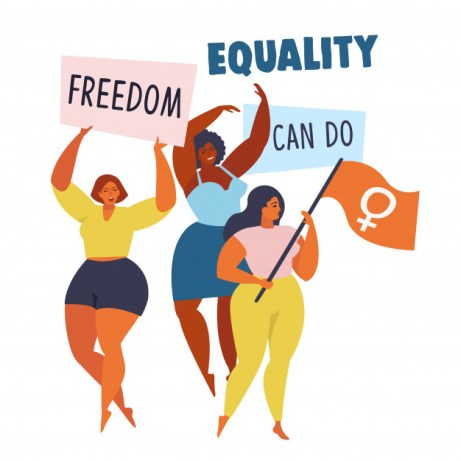
Women have always been diminished in society, by creating ideas that women are not “fit” to work in another place other than home. Additionally, women were undermined because of their physical aspect. For this reason, ideas such as women only being “fit” of taking care of the children and the house circulated. However, even though society has progressed and women have proven that they are as valuable as men, the differentiation between gender continues. Not only the differentiation between gender but also in race continues, specifically seen in wages.
The wage gap between women and men has always been present but the wage gap between Latina women and males is greater. Latina women are being undermined when being paid less for the same work done by men. According to the National Partnership for Women and Families, women are paid 80 cents for every dollar paid to men, however, Latina women are only paid 54 cents for every dollar paid to White non-Hispanic men. This is unacceptable because many women are the sole providers for their family and they are being deprived of money they should be receiving. The differentiation between races has a greater effect for these Latina women because not only are they earning less because they are women, but also because of their race.
However, it is not a surprise that women are undermined since this has been projected for centuries. Although the undermining of women in the past was different from the issue of wages the idea of women being weaker has been present. For example in the Roman Empire, daughters of the emperors were seen as political alliances through marriage. Specifically, in The Aeneid, Lavinia, daughter of Latinus, was set to marry Aeneas even though she did not know who he was and her mother implored for it to be impeded, “As Lavinia heard her mother’s pleas, her warm cheeks bathed in tears…” (12.357). Lavinia’s mother was not able to prevent this arranged marriage or Lavinia because they did not have the right to have an opinion. Even though society has progressed from these ideas of women being controlled by the men, illustrated in The Aeneid, there are still issues in undermining women present.
Moreover, Rousseau illustrates how civilization has moved passed the old beliefs yet society still retains them. In The Basic Political Writings, Rousseau describes that the more humans learn, the more they drift away from values and ideas that are truly important, “…moves away from its primitive state, the more we deprive ourselves… most important knowledge” (Cress 39). Living in the 21st century would seem that society has progressed, however, the old ideas are still portrayed despite all the movements that have occurred. Women have proved that they are equal to men, therefore deserve equality. For example, in the wage gaps between Latina women and men, where they should be paid equally. Race and gender should not be an excuse for the difference in wages, especially since in this century many have fought for equality. Because of these causes, society should move on from distinctions between gender and race.
Throughout history women and races have been undermined and continue to do so even though society has progressed and demonstrated that this should not continue. Although women are now able to work and do not live with the stereotype of “women should tend the home and children”, they are still diminished and more because of their race. It is unfair that women are still being undermined in a new form which is in wages. Being a woman or a man or a different race is not an excuse for undermining people because they are all humans and have the same potential.
Bibliography:
Rousseau, Jean-Jacques. Basic Political Writings: Discourse on the Sciences and the Arts Discourse on the Origin of Inequality; Discourse on Political Economy; On the Social Contract. Hackett Pub. Co., 1987.
The National Partnership for Women and Families. “Latinas and the Wage Gap.” Fact Sheet, The National Partnership for Women and Families, Apr. 2018, http://www.nationalpartnership.org/research-library/workplace-fairness/fair-pay/latinas-wage-gap.pdf.
Virgil. The Aeneid. Translated by Robert Fagles Penguin Books, 2006, Book 12

